
Industrial Supply World is reader-supported. When you buy through links on our site we may earn an affiliate commission; it never affects our recommendations or your price. Prices were checked October 25, 2026.
Ten years ago this was easy: air for real work, cordless for convenience. Today a $300 brushless cordless impact out-torques most air impacts on the shelf. So the question has changed. It is no longer which is stronger; it is what you already own and where you use it.
Cordless vs air at a glance
| Cordless | Pneumatic | |
|---|---|---|
| Top rated torque (big-box models) | 1,400 to 1,600 ft-lb nut-busting | 1,100 to 1,300 ft-lb nut-busting |
| What else you need | Batteries and charger | 4 to 5 CFM compressor, 3/8" hose, coupler |
| Runtime | Until the battery dies | As long as the compressor keeps up |
| Weight | Heavier with a big battery | Lighter for the torque |
| Portability | Anywhere | Tethered to a hose |
| Cost if you own nothing | $400 to $500 with batteries | $600+ with a compressor that can run it |
| Best for | Home garage, roadside, jobsites | All-day shop use, tire work |
Torque figures are manufacturer ratings for the models listed below.
Each type, honestly
Cordless (battery)
Brushless cordless impacts caught up. The top 18V and 20V models now match or beat mid-range air impacts on rated torque, with no hose, no compressor and no pressure drop. You grab it and go: driveway, roadside, trailer, job. The trade-offs are battery cost, weight (a big battery makes a heavy tool), and that runtime ends when the pack does.
- No compressor, hose or coupler needed
- Goes anywhere
- Top models match air on torque
- Batteries are expensive and wear out
- Heavier than an air tool of the same output
- Stops when the battery does
Pneumatic (air)
An air impact is light, simple and nearly indestructible, and it runs as long as the compressor keeps up. That is why tire shops and fleet garages still run air. The catch is everything behind it: a compressor that makes 4 to 5 CFM at 90 PSI, a 3/8" hose and a decent coupler. Without that, an air impact never reaches its rating.
- Light and compact for the torque
- Unlimited runtime
- Cheap to buy and to rebuild
- Needs a real compressor (4 to 5 CFM)
- Tethered to a hose
- Loud
Start with what you already own
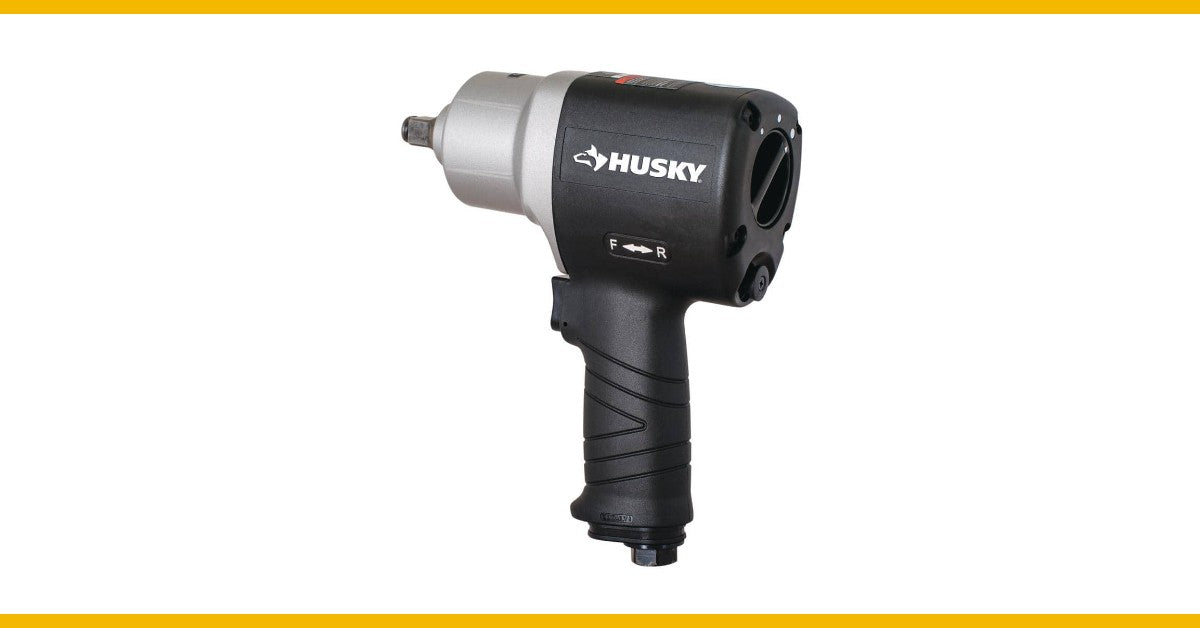
- You already have a 20+ gallon compressor that makes 4.5 CFM or more: buy an air impact. A $139 Husky on a good compressor and a 3/8" hose is hard to beat.
- You have a pancake or no compressor: go cordless. A pancake cannot feed a 1/2" air impact, and buying a compressor just to run one costs more than a cordless kit.
- You are already on a battery platform: buy that brand's impact tool-only. Milwaukee, DeWalt, Kobalt and Ryobi all make a good one.
- You work in a shop all day: keep air for the bench, add cordless for the jobs that walk away from the compressor. Most pros run both.
If you go air, the hose and coupler matter as much as the wrench. See our air impact wrench guide and the air line calculator.
Good examples of each


No compressor, or only a pancake: buy cordless, and the Milwaukee M18 FUEL if budget allows. A real compressor already in the garage: an air impact is the better value and lasts longer. Running a shop: own both.
Related on Industrial Supply World
- Best 1/2" air impact wrenches
- Best air compressors for a home garage
- Oil-free vs oil-lubricated compressors
Industrial Supply World is run by Mid-States Industrial Sales, a 40-year industrial distributor in Elgin, Illinois. Questions? support@industrialsupplyworld.com